





Room Booking in Outlook: Is It Enough for Your Organisation?
Outlook is enough for room booking as long as each room is booked on its own: room mailboxes accept requests automatically, decline conflicts and enforce booking rules. What is missing is everything beyond the single room: one view of all rooms with pending approvals, moving meetings that are already booked, and catering in the same step.
This page is written for facility and office management and for IT. It shows what room mailboxes do out of the box, where the built-in tools stop, with the limits from Microsoft’s documentation, and when you do not need any additional software.
How Does Room Booking in Outlook Work?
In Exchange Online, every meeting room is a room mailbox with its own calendar. Booking a room means inviting that mailbox to the meeting like an attendee. The room mailbox checks the request against its calendar and booking rules and replies automatically with an acceptance or a decline. Room Finder and Places Finder are simply search interfaces on top.
A room mailbox is a resource mailbox in Exchange that represents a physical room. It has an email address, a calendar and booking rules, but no person reading the requests. Exchange decides, based on the rules IT has set on the mailbox.
How a booking works:
- You create a meeting in Outlook and add the room as the location or as an attendee.
- Exchange checks: is the room free? Is the meeting within the permitted booking window, within the maximum duration and, if required, within working hours?
- The room accepts or declines. The reply arrives by email, with a reason if it is a decline.
Users find the right room through Room Finder or, in newer tenants, through Places Finder. Both read the same room mailboxes; according to Microsoft, room booking in Microsoft Places is also based on Exchange resource mailboxes. If you do not know a room’s address, you can still get there without searching: click Location in the meeting, choose All Rooms in the address book and double-click the room to add it. How the search works in detail and where it falls short is covered in Room Finder in Outlook and its limits.
Besides rooms, Exchange also has equipment mailboxes, for example for projectors, facilitation kits or vehicles. They work like room mailboxes: the item is invited as another attendee and accepts automatically.
What Can Room Mailboxes Do Out of the Box?
More than most organisations use. A room mailbox prevents double bookings, limits how far ahead and for how long a room can be booked, can restrict bookings to working hours and can forward requests to named people for approval. All of this is set with Set-CalendarProcessing in Exchange Online PowerShell, and partly in the Exchange admin centre.
The values that matter when deciding whether Outlook is enough:
- Automatic processing (
AutomateProcessing, defaultAutoAcceptwhen created in the admin centre): the room accepts or declines without any human involvement. - Booking window (
BookingWindowInDays, default 180 days, adjustable from 0 to 1080): anyone booking further ahead receives a decline. - Maximum duration (
MaximumDurationInMinutes, default 1440 minutes, i.e. 24 hours): longer meetings are declined; for recurring meetings the value applies to each occurrence. - Working hours only (
ScheduleOnlyDuringWorkHours, default off; working hours 8 am to 5 pm, Monday to Friday): by default, rooms can also be booked in the evening and at weekends. - Conflicts (
AllowConflictsoff,ConflictPercentageAllowed0 per cent,MaximumConflictInstances0): a single occupied occurrence makes an entire recurring meeting fail. - Series beyond the booking window (
EnforceSchedulingHorizon, default on): a recurring meeting that extends beyond 180 days is declined. - Subject in the room calendar (
DeleteSubjectandAddOrganizerToSubject, default on): the room calendar shows the organiser’s name instead of the subject. - Visibility of the room calendar (default permission
AvailabilityOnly): anyone opening the room calendar only sees free or busy. - Approval by people (
ResourceDelegates, default empty): named delegates can accept or decline requests.
Many complaints that “Outlook books incorrectly” are really default values nobody has changed. Going through this list with IT once solves part of the problem without any software at all.
Why Does a Room Decline an Entire Recurring Meeting?
Because Exchange does not allow conflicts in recurring meetings by default. ConflictPercentageAllowed and MaximumConflictInstances are set to 0: if even one occurrence of the series is already taken, the room declines the whole series. The same happens if the series extends beyond the 180-day booking window. Both can be changed, but not without side effects.
Two settings, two consequences:
- Allow conflicts. Raising
ConflictPercentageAllowedorMaximumConflictInstancesgets the series accepted. The room still declines the conflicting occurrences. The organiser then has to work out on which days they are left without a room. - Shorten instead of decline. With
EnforceSchedulingHorizon $false, the room accepts a long series but quietly cuts it off at the end of the booking window. The series continues in the organiser’s calendar; the room does not.
Neither setting is wrong. Both shift the problem from the room mailbox to the organiser. What else to consider when creating, changing and cancelling a series is covered in recurring meetings with a room in Outlook.
The same applies to arbooMEET. arbooMEET is an add-in, bookings are made exclusively in Outlook, and so the room mailbox rules apply unchanged. What arbooMEET adds to recurring meetings sits one level above: catering and services attached to a series are distributed across all occurrences of that series.
How Do You Move an Outlook Meeting to a Different Room?
Only through the organiser. They open the meeting, remove the old room, choose a new one and send the update to everyone. Anyone who is not the organiser needs delegate access to the organiser’s calendar. A facility team that needs to free up a room therefore cannot move someone else’s meeting with the built-in tools; it can only ask.
The steps in Outlook:
- Open the meeting in the calendar.
- Remove the old room from the attendee list.
- Choose a new room using Add Rooms or the Location field. If the list is empty, check availability in the Scheduling Assistant.
- Mention the change of room in the invitation text.
- Send the updated invitation to everyone.
In practice, this goes wrong in three places:
- The old room stays booked. The room mailbox is an attendee of the meeting. Clearing only the Location field instead of removing the room from the attendee list leaves it booked in some cases. It then has to be removed as an attendee afterwards.
- Additional services do not follow. Catering, equipment or room changes ordered for the old room have to be rebooked or cancelled separately.
- The new room is not equivalent. Projector, video conferencing system and capacity of the new room all need to be checked again.
In arbooMEET’s all-rooms calendar, whoever manages it moves the booking straight to another room. The organiser’s meeting moves, booked catering moves with it, and attendees receive an updated invitation from Exchange, exactly as if the organiser had changed the room themselves. Whether the new room has the same equipment remains a matter for the facility team to check.

Why Is There No Overview of All Rooms in Outlook?
Outlook can open several room calendars side by side. By default, though, they only show free or busy, and the organiser’s name appears instead of the subject. Pending approvals, blocked periods and moving other people’s meetings are not part of this view. In practice, Outlook also becomes slow and hard to read once three or four room calendars are open.
What the built-in tools offer: in the calendar, under My Calendars, Add Calendar → From Room List lets you show any room as its own calendar, side by side or overlaid. That is the usual answer to the question of room availability, and for two or three rooms it is enough.
Why this still does not add up to an overview:
- The permission is not enough. Room calendars default to
AvailabilityOnly. Seeing more requires at leastLimitedDetails, and IT has to grant this for each room mailbox. - The subject is missing anyway. With the default values of
DeleteSubjectandAddOrganizerToSubject, Exchange replaces the subject with the organiser’s name. Even with more rights, the entry reads “Anna Müller” rather than “Board Meeting”. - Approvals sit in a mailbox, not in the calendar. Rooms with an approval process send each request as an email to the delegate. No view shows which requests are still pending across all rooms.
- Blocking only works with a placeholder. Blocking a room for a period, for example during a refurbishment, is only possible by booking the room yourself with a placeholder meeting. The
BookingType Reservedsetting, by contrast, blocks the room entirely, not for a period. - Moving only works through the organiser (see above).
- Outlook slows down. Anyone who opens more than three or four room calendars at once gets an Outlook that responds with a delay and becomes barely readable. No documentation says so; anyone who has worked this way knows it.
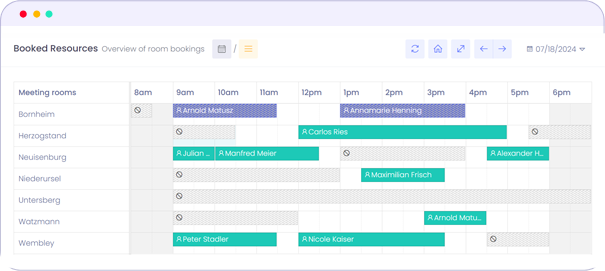
What arbooMEET’s all-rooms calendar does differently. It shows the bookings of all Exchange Online room mailboxes on a single page. Visible and actionable there:
- which rooms are booked and when,
- which approvals are pending, both room requests to the room mailbox’s delegates and approvals for catering and services,
- blocking rooms for a period; the room then also shows as busy in Room Finder and when booked directly in Outlook,
- moving bookings to a different room, with catering and an update to all attendees.
Searching for a free room stays with Room Finder in Outlook. arbooMEET does not replace it.

Where Does Outlook Fall Short with Multiple Sites?
At Room Finder. It returns a maximum of 100 rooms per search, Microsoft recommends no more than 50 rooms per room list, and each room list may only contain rooms from one city. City, floor and capacity must be maintained for every room, and changes only appear after 24 to 48 hours. For multiple sites this means maintenance effort, but it is manageable.
What Microsoft specifies for Room Finder:
- A maximum of 100 rooms is returned per search. There is no hard limit per room list, but for good performance Microsoft recommends no more than 50 rooms per list.
- One room list, one city. If a list mixes rooms from several cities, it only appears under the city where most of its rooms are located.
- Same domain. The rooms in a list must share the SMTP domain of the list itself.
- Required properties. City, floor and capacity must be set for every room, otherwise Room Finder cannot filter properly.
- Delay. Changes to rooms and room lists only appear after 24 to 48 hours.
- Room lists can only be created with PowerShell, not in the admin centre.
In parallel, Microsoft is introducing Places Finder. It organises rooms by building and floor rather than by room list. For tenants onboarded from 1 August 2026 it is switched on by default; for older tenants with room lists it remains optional. Each user sees either Room Finder or Places Finder, never both. Microsoft says it is evaluating the deprecation of Room Finder; no deprecation has been announced so far.
Because arbooMEET relies on Room Finder for room search, these limits also apply to arbooMEET customers. The difference lies in administration: in the all-rooms calendar, facility teams see all room mailboxes on one page, and bookable resources can be managed independently for each site.
What Can't Outlook Book with the Room?
Anything that is not a room or a piece of equipment. Exchange knows nothing about catering, seating or services. Equipment can be booked as an equipment mailbox, but each item is another attendee, accepts automatically, and whoever has to provide it never hears about it. Technically solved, in everyday use not.
In detail:
- Equipment. An equipment mailbox set to
AutoAcceptconfirms every booking without a person ever seeing it. A person only receives the request if they are set up as a delegate, and then as a separate email per request. Anyone who needs five items for a workshop invites five mailboxes, and in the morning there is still no projector in the room because nobody was watching the equipment calendar. - Catering and services. The built-in tools only offer workarounds: notes in the invitation, categories, tasks, templates. None of them creates an order with quantity, lead time and a responsible team. The five workarounds and their limits are covered in booking a meeting room and catering in Outlook.
- Seating. Room mailboxes know capacity, but not the seating layout. Which layout suits which meeting is shown in meeting room seating arrangements compared.
- Microsoft Places does not change this. According to Microsoft, its “Services” building block consists of web links and Teams apps; Microsoft’s own example is a link to a canteen’s website. Places links to catering; it does not book it.
In arbooMEET, catering, seating and services are booked in the same Outlook meeting as the room, and the responsible teams are notified. Guests can be registered in the same meeting too: registering guests in the same Outlook meeting with arbooGREET.
Is Outlook Enough for Your Room Booking? The Decision Guide
Outlook is enough when rooms are booked individually and nobody has to manage them together. As soon as a team needs to keep track of pending approvals across all rooms, block rooms, move other people’s meetings or organise catering for a meeting, the tools are missing. The overview shows where Outlook alone is enough, where arbooMEET adds to it and where arbooMEET does not help either.
Where Outlook Is Enough and arbooMEET Changes Nothing
- Booking a room with conflict checking. Outlook: yes, by default. With arbooMEET: unchanged, bookings are made in Outlook.
- Booking rules for lead time, duration, working hours and recurring meetings. Outlook: via parameters on the room mailbox. With arbooMEET: unchanged, the Exchange rules apply.
- A recurring meeting with one occupied occurrence. Outlook: by default the whole series is declined; this can be relaxed with parameters. With arbooMEET: the same, arbooMEET follows the Outlook rules.
- Room search across sites. Outlook: Room Finder or Places Finder, a maximum of 100 results per search. With arbooMEET: the same, arbooMEET uses Room Finder.
Where arbooMEET Adds What Outlook Lacks
- All rooms on one page. Outlook: side by side is possible, but only free or busy, and slow from three or four calendars. With arbooMEET: an all-rooms calendar across all room mailboxes.
- Pending approvals across all rooms. Outlook: no, individual emails to the delegate. With arbooMEET: in the all-rooms calendar, for room requests and for catering and services.
- Blocking a room for a period. Outlook: only with a placeholder meeting. With arbooMEET: in the all-rooms calendar; the room then also shows as busy in Room Finder and in Outlook.
- Moving someone else’s meeting to another room. Outlook: only the organiser or their delegate. With arbooMEET: in the all-rooms calendar; catering moves with it, and attendees receive an update.
- Projectors, facilitation kits, equipment. Outlook: one equipment mailbox per item, nobody is notified. With arbooMEET: as a service in the meeting, and the responsible team is notified.
- Catering and seating. Outlook: cannot be booked, only notes and workarounds. With arbooMEET: in the same meeting as the room.
- Orders for every occurrence of a recurring meeting. Outlook: not available. With arbooMEET: distributed across all occurrences of the series.
- Booking analysis. Outlook: via PowerShell from Exchange logs; according to Microsoft, Places analytics may require an additional licence. With arbooMEET: analysis of how rooms and extras were booked; it measures bookings, not attendance.
Where arbooMEET Doesn’t Help Either
- Room mailboxes outside Exchange Online. Outlook: also works with Exchange Server. With arbooMEET: Exchange Online is required.
Outlook alone is enough if both of these apply:
- One person can keep track of the rooms without opening more than three or four calendars.
- Catering, equipment or room changes are rarely or never ordered for meetings.
If either does not apply, it is worth looking at an Outlook room booking system such as arbooMEET.
What arbooMEET Adds and What It Doesn't
arbooMEET is an add-in for Outlook. Bookings are still made in Outlook, on the same room mailboxes, under the same Exchange rules. arbooMEET adds what Exchange does not know: the all-rooms calendar, catering, seating and services in the meeting, and the distribution of orders across recurring meetings. It has no booking logic of its own alongside Exchange.
What arbooMEET adds:
- All-rooms calendar across all Exchange Online room mailboxes: occupancy, pending approvals, blocked periods, moving bookings to another room.
- Catering, seating and services in the same meeting as the room, with lead times and responsible teams.
- Approvals by a team. Approvals for catering and services go to the responsible team, not to a single person. There is always someone available, so no deputy arrangement is needed.
- Recurring meetings: orders attached to a series are distributed across all occurrences.
- Analysis of how rooms were booked and which extras were ordered.
- No new tool, no new login. Organisers work in the Outlook meeting they create anyway.
What arbooMEET is not:
- Not a separate room search. Search stays with Room Finder.
- Not a separate set of booking rules. IT continues to set the booking window, maximum duration and conflict checking on the room mailbox.
- Not an attendance measurement tool. It analyses bookings, not sensor data.
How the introduction affects the individual roles is described on the page about how arbooMEET changes the workday for users, office and facility management and the catering team.
When Don't You Need arbooMEET?
When the built-in tools can carry your rooms. An organisation with four rooms and no catering does not need arbooMEET. Well-configured room mailboxes and a Room Finder with maintained room lists are then the better solution, because they cost nothing and introduce nothing new.
We are also the wrong choice in these cases:
- Few rooms, no approvals, no catering. Take the list of default values above to IT and adjust them.
- You want to measure whether rooms are actually used. For that you need sensors. Booking data shows what was booked, not who was there.
- Your room mailboxes are not in Exchange Online. arbooMEET requires Exchange Online room mailboxes.
- You are looking for desk booking. That is what arbooONE is for.
What Does IT Need to Know?
arbooMEET is an Outlook add-in and works through the Microsoft Graph API with delegated calendar access. Rooms remain Exchange Online room mailboxes, and their booking rules remain on the mailbox. Booking and order data is stored per customer in a separate, dedicated database outside the Microsoft 365 tenant; if you prefer, you can run arbooMEET in your own Azure subscription.
- Room mailboxes remain the foundation. IT remains responsible for creating rooms, room lists and
Set-CalendarProcessing. arbooMEET does not introduce a second resource management layer. - Data storage. Booking and order data is held in a product-specific database created individually for each customer and kept separate from other customers’ data. The meeting itself also appears in users’ calendars as usual.
- Operation. Hosting is on Azure with data residency in the EU or Germany. On request, arbooMEET is installed in the customer’s own Azure subscription.
- Data processing agreement. An established template for the data processing agreement and documentation of sub-processors are available.
- Rollout. Deployed as an add-in in a managed tenant; what this means for permissions and admin consent is covered in rolling out Outlook add-ins in a managed tenant.
Frequently Asked Questions
How Do I Book a Room in Outlook?
Create a meeting and add the room as the location or as an attendee, either through Room Finder or via Location → All Rooms. Exchange checks availability and booking rules and replies with an acceptance or a decline. Only the acceptance confirms the booking.
How Can I See Room Bookings in Outlook?
Under My Calendars → Add Calendar → From Room List, you can show room calendars. By default, you only see free or busy and the organiser instead of the subject. With several rooms at once, this quickly becomes hard to follow. How to find free rooms is covered in Room Finder in Outlook and its limits.
Can I Move an Outlook Meeting to a Different Room?
Yes, if you are the organiser or have delegate access to their calendar: remove the old room, add the new one, send the update. Any additional services you booked have to be rebooked separately. Otherwise, you can only ask the organiser to move the meeting.
Does Microsoft Have a Room Booking System?
Yes: room mailboxes in Exchange Online, booked through Outlook. Microsoft Bookings is not a room booking system; it is designed for appointments with customers, such as consultations. According to answers on Microsoft Q&A, Bookings does not invite room mailboxes or check their availability; the location field is for information only.
Why Does the Room Decline My Booking?
Because one of the room mailbox’s rules applies: the room is booked, the meeting is further ahead than the booking window, lasts longer than allowed, falls outside working hours or is a series with an occupied occurrence. The decline states the reason. Or you do not have permission to book the room.
Does Microsoft Places Replace Room Booking in Outlook?
No. According to Microsoft, room booking in Places is based on the same Exchange room mailboxes. Places adds Places Finder, a new search interface organised by building and floor, plus further features, some of which may require an additional licence according to Microsoft. The limits of room mailboxes remain.
Room booking in Outlook, with the overview Outlook doesn’t have. Find out more about arbooMEET, or see the all-rooms calendar in a live demo with your own rooms.
Related Content


Meeting Room Booking as It Should Be, Straight from Microsoft Outlook

Join hundreds of satisfied clients across various industries who trust arboo to handle their office needs,
so they can focus on what truly matters. Will you be next?
